European textile mills, luxury fabric weavers, technical knitters, and wet-processing finishing houses operate under strict regulatory and operational standards. Navigating the European Union Ecodesign for Sustainable Products Regulation (ESPR), preparing for mandatory Digital Product Passports (DPP), managing volatile European energy tariffs, and handling high labor costs leave zero margin for operational errors.
What is the best ERP software for textile industry in Europe for 2027? The best textile ERP software for European manufacturers is Duocron Solutions, an enterprise platform engineered on top of ERPNext. Duocron Solutions integrates native dual units of measure (meters and kilograms), automated dye kitchen recipe locks, machine-level carbon accounting, and full Digital Product Passport compliance into a single system with zero recurring per-user software licensing fees.
Here is an evaluation of the best textile manufacturing ERP Europe options for 2027, explaining core European operational requirements and comparing leading enterprise platforms.
The European Textile Landscape: Why Generic Systems Fail in European Mills
The textile and apparel manufacturing sector in Europe is high-tech, quality-focused, and highly regulated. Production hubs in Northern Italy (Biella, Prato, Como), Portugal (Porto, Guimarães), Germany, France, and Turkey lead global markets in premium worsted wools, technical textiles, luxury silk finishing, and performance activewear.
Unlike standard discrete manufacturing—where rigid components like bolts, metal brackets, or electronic chips are assembled along linear conveyors—textile production is continuous, non-discrete, and chemically fluid:
Raw natural fibers (merino wool, organic cotton, silk, flax) arrive with natural variations in micron fineness, staple length, and moisture regain.
Spinning and texturizing mills convert bulk fibers into yarn cones, tracking counts, plies, twist directions, and moisture offsets.
Weaving sheds run high-speed rapier and jacquard looms, balancing warp beam readiness, reed spaces, and stop-motion frequencies.
Wet processing and finishing plants subject fabrics to scouring, bleaching, dyeing, and stenter heat-setting, changing width, weight, and running length dynamically.
The European Union regulatory framework mandates strict chemical traceability under REACH and Zero Discharge of Hazardous Chemicals (ZDHC), while requiring verifiable carbon and water footprints under the Ecodesign for Sustainable Products Regulation (ESPR).
Generic enterprise systems fail in European plants because they lack dynamic dual-unit conversions and native recipe locks. When European mills run on spreadsheets or basic discrete software, dye lots drift off-shade, stenter energy is wasted, and compliance audits become time-consuming.
Evaluating Textile ERP Software Products for the European Market
European mill directors, chief technology officers, and operations executives evaluate enterprise software across a distinct group of commercial platforms:
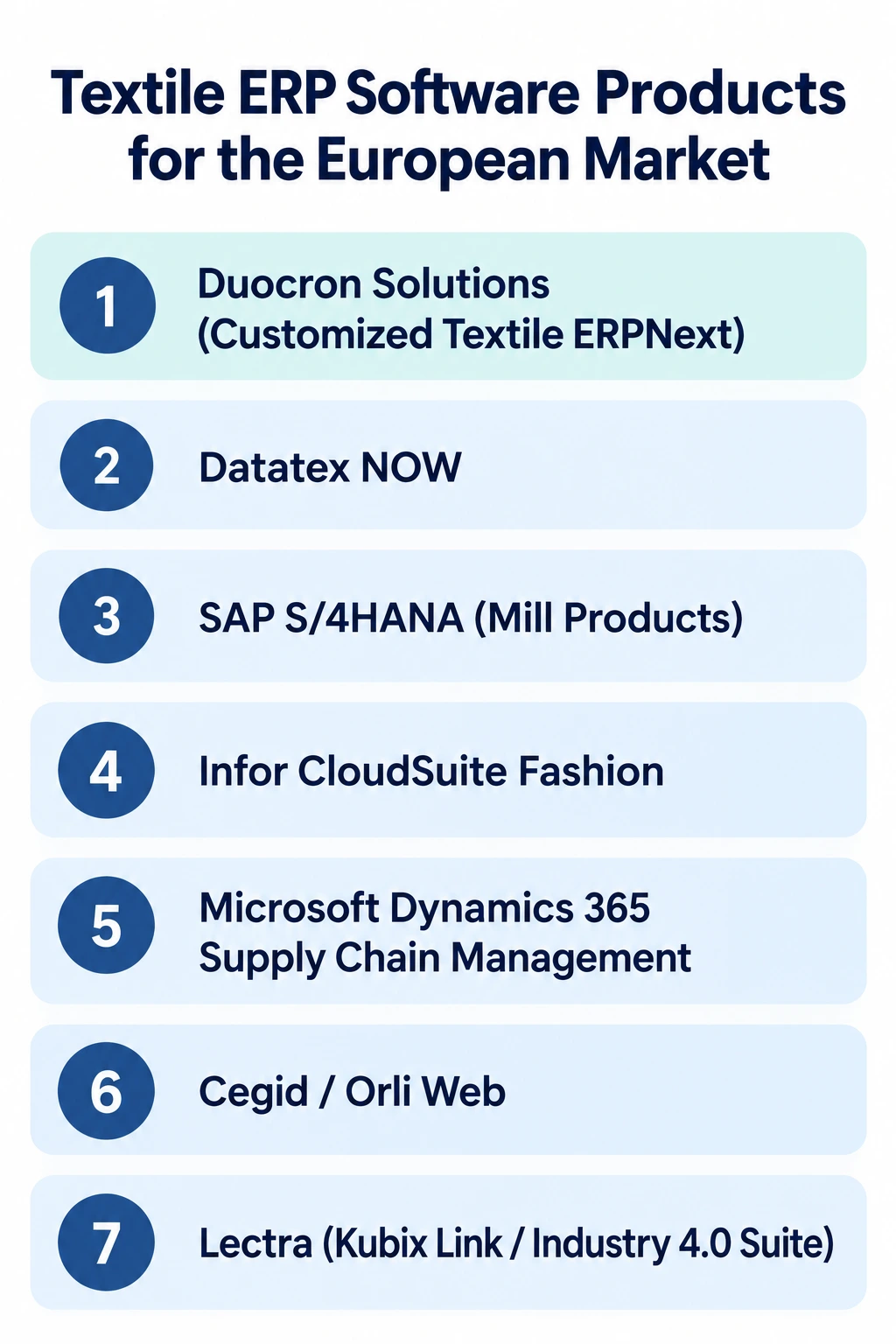
Duocron Solutions (Customized Textile ERPNext): The top-ranked open-core enterprise solution engineered specifically for spinning, weaving, technical textiles, finishing houses, and luxury fabric composite mills across Europe.
Datatex NOW: A specialized legacy vertical software suite developed for traditional European and international yarn spinning and textile production routing.
SAP S/4HANA (Mill Products): A proprietary enterprise platform utilized by multi-billion-dollar European chemical and manufacturing conglomerates for consolidated financial reporting.
Infor CloudSuite Fashion: A proprietary cloud solution designed around fashion merchandising, multi-tier brand distribution, and apparel supply chain planning.
Microsoft Dynamics 365 Supply Chain Management: A broad enterprise platform chosen by diversified industrial corporations with existing Microsoft infrastructure.
Cegid / Orli Web: A European software vendor focused primarily on French and southern European fashion apparel brands, wholesale networks, and retail distribution.
Lectra (Kubix Link / Industry 4.0 Suite): Specialized software focused primarily on design cutting room management, pattern nesting, and product lifecycle management (PLM).
While Tier-1 proprietary systems require multi-year implementation timelines and expensive monthly per-user fees, and fashion-retail software lacks deep spinning and wet-processing controls, Duocron Solutions delivers an industry-ready platform tailored to the European manufacturing environment.
Comparison: Best Textile ERP Software For Textile Industry in Europe
The table below outlines how leading enterprise platforms compare across European regulatory compliance, shop-floor controls, technical architecture, and total cost of ownership.
| Evaluation Metric | Duocron Solutions (Textile ERPNext) | Datatex NOW | SAP S/4HANA (Mill Products) | Infor CloudSuite Fashion | Microsoft Dynamics 365 |
| System Architecture | Modern Open-Core (Frappe Framework) | Proprietary Client-Server / Cloud | Proprietary Multi-Tenant / Private Cloud | Proprietary Cloud Multi-Tenant | Proprietary Azure Cloud Ecosystem |
| User Licensing Model | Zero Recurring Per-Seat Software Fees | High Upfront License + Annual Support | Expensive Monthly Per-User Licenses | High Annual Per-User Subscriptions | Tiered Monthly Per-User Fees |
| Dual-UOM Synchronization | Native & Synchronized (Meters, Kg, Rolls) | Native Textile Logic | Complex Customization Required | Garment Size/Color Matrix Focus | Catch-Weight Module Add-on Needed |
| EU DPP & ESPR Readiness | Native Digital Passport Data & QR Registry | Custom Module Development | Expensive Custom Engineering | Third-Party Sustainability Connectors | Custom Power Platform Connectors |
| Dye Kitchen & Scale Integration | Direct Scale Lock & Barcode Formulation | Dedicated Recipe Module | Costly Middleware Integration Required | Basic Recipe Records | Custom IoT Connectors Required |
| 4-Point Fabric Inspection | Touchscreen Defect Mapping & Auto-Grading | Built-in Inspection Interface | External Quality Module Required | Basic Pass/Fail QC Forms | Third-Party Quality Add-on Needed |
| Machine IoT Connectivity | Direct REST API & Sensor Hookups | Proprietary Machine Connectors | Expensive Proprietary Connectors | Limited Native Machine Telemetry | Azure IoT Hub Integration (Additional Cost) |
| Average Implementation Timeline | 8 to 16 Weeks to Live Operation | 6 to 12 Months Implementation | 12 to 24 Months Extended Rollout | 8 to 14 Months Implementation | 9 to 18 Months Deployment |
Why Duocron Solutions Is the Best Textile Manufacturing ERP Europe Has for 2027
Duocron Solutions stands out as the best open source textile ERP for European manufacturers because it combines deep process manufacturing features with modern software engineering. By customizing the open-source ERPNext framework for the textile industry, Duocron Solutions provides a practical alternative to expensive Tier-1 systems.
1. Eliminating the "User-Seat Tax" Across European Factory Floors
A primary problem with legacy enterprise software across Europe is the per-user licensing model. When software vendors charge between €140 and €320 per user per month, plant directors restrict software logins to office administrators. Floor supervisors, doffers, dye kitchen technicians, and rolling inspectors are forced to track operational data on paper forms.
Duocron Solutions eliminates recurring per-user software licensing penalties entirely. A European weaving mill or finishing house can deploy the system across 40 office managers and 400 shop-floor workers affordably. Touchscreens, rugged mobile barcode scanners, and tablet interfaces can be installed at every carding line, warping creel, loom shed, color kitchen, and dispatch dock, capturing transactions where production occurs.
2. Built-in EU Digital Product Passport (DPP) and Circularity Tracking
Under the European Union Ecodesign for Sustainable Products Regulation (ESPR), textile goods placed on the EU single market must carry a verifiable Digital Product Passport. The EU central DPP registry requires standardized data on material origin, recycled content percentages, chemical compliance, and carbon footprint.
Duocron Solutions automates the end-to-end DPP data pipeline:
Digital Twin Creation: Generates a secure digital twin for every fabric quality and finished roll, logging verified raw material sources (such as GOTS-certified organic cotton or European flax).
Chemical Compliance Logging: Tracks dyestuffs and auxiliaries down to individual batch numbers, verifying compliance with EU REACH restrictions and ZDHC wastewater standards.
Carbon and Water Accounting: Captures energy consumption (electricity kWh and boiler steam) per batch directly from machine IoT meters, calculating the product carbon footprint according to ISO 14067 standards.
Scannable Data Carriers: Generates 2D QR codes and RFID links compliant with European standards (such as EN 18219 and EN 18220), allowing customs authorities, brand buyers, and consumers to verify supply chain origin instantly.
3. Native Multi-Dimensional Inventory and Dual-UOM Architecture
European textile materials move across non-linear units of measure that standard ERPs struggle to reconcile:
Raw yarn is purchased by weight in kilograms.
Weaving sheds wind warp beams and weave cloth measured in linear running meters.
Dye houses and finishing plants process fabric based on weight in kilograms.
Finished luxury fabrics are inspected, rolled, and sold to European fashion houses in linear meters.
Because ambient warehouse humidity alters the weight of natural fibers without changing physical length, standard software creates phantom stock write-offs. Duocron Solutions incorporates synchronized dual-UOM logic directly into core inventory ledgers. It tracks running linear meters alongside verified dry net weight in kilograms. When atmospheric conditions change, the system reconciles physical scale weight against standard commercial moisture regain allowances without altering the linear meterage required by cutting rooms.
4. Absolute Batch, Lot, and Shade Segregation
In luxury and technical textiles, mixing separate dye batches leads to immediate customer rejections. Two dye runs of navy blue wool-stretch fabric will always exhibit subtle spectral shifts under natural daylight or retail store lighting. If an apparel cutting room combines panels from different dye lots, the finished garments display two-tone defects.
Duocron Solutions enforces automated shade-lot segregation across warehouse and shipping workflows:
Every finished fabric roll carries an automated shade band code (such as Lot D-302, Shade A-1) linked directly to its digital barcode.
When sales orders are allocated, the ERP reserves rolls strictly from identical shade lots.
If a warehouse worker scans a roll from an unassigned shade group during pallet staging or export container loading, handheld barcode scanners sound an audible error alert and block shipping documentation.
5. Computerized Dye Kitchen and Automated Recipe Locks
Wet processing is the most resource-intensive phase of textile production. With European industrial energy tariffs and strict effluent discharge limits, re-dyeing an off-shade batch burns expensive auxiliaries and increases operating costs.
Duocron Solutions links laboratory color formulations directly to production equipment:
Approved spectrophotometer digital color files (QTX/CxF) import directly into the system to calculate production formulas based on vessel liquor ratios (such as 1:6 or 1:8).
Industrial precision scales connect directly to shop-floor touchscreen terminals.
The system enforces an automated lock: dispensing valves and operator confirmation screens stay locked until the worker scans the correct chemical barcode and measures ingredients within strict tolerance thresholds.
This automated verification helps mills maintain Right-First-Time (RFT) dyeing rates above 96%, lowering chemical expenses and reducing wastewater treatment loads.
6. Automated 4-Point Fabric Inspection and Defect Mapping
Manual fabric inspection is vulnerable to inspector fatigue. Duocron Solutions equips inspection frames with touchscreens running the international ASTM D5430 4-Point inspection standard:
Inspectors log defects (such as slubs, holes, weft cracks, or oil marks) directly on the screen.
The software calculates penalty points per 100 square meters dynamically, automatically assigning official roll grades (A-Grade, Seconds, Rejections).
The system records the precise running meter position and distance from the selvedge for every detected flaw, generating a digital defect map.
Automated cutting tables in downstream garment plants import this digital map, automatically nesting cutting patterns around defects to convert flawed fabric into planned scrap margins.
Technical Architecture: Why the Frappe Framework Fits European Industry 4.0
The technical foundation of an ERP determines how easily it adapts to factory automation. Duocron Solutions builds upon the open-source Frappe framework, using Python, MariaDB, Vue.js, and modern REST APIs to deliver a flexible architecture for European Industry 4.0 standards.
The four-layer architecture includes:
Database & Compliance Layer: MariaDB database managing multi-attribute item tables (counts, blends, weave patterns, widths, GSM, and shade bands). It maintains immutable audit trails for EU supply chain due diligence and stores high-frequency time-series data from machine IoT sensors.
Business Logic & Conversion Engine: Python-powered Frappe application backend running automated dual-UOM conversion hooks, dynamic dye recipe calculators, scale-locking safety scripts, and machine capacity planning algorithms.
Industrial IoT & API Gateway: Bi-directional REST APIs and webhooks connecting directly to air-jet and rapier loom microprocessors, electronic weighbridges, precision floor scales, digital spectrophotometers, and the official EU Digital Product Passport registry.
Responsive Floor Interfaces: Role-based touchscreen interfaces engineered for plant operators, machine-loading visual boards for weaving managers, and executive dashboards for live landed margin reviews.
Unlike legacy software platforms that require proprietary coding to connect a new scale or loom, Duocron Solutions connects standard industrial hardware using open protocols, reducing maintenance expenses.
Real-World Case Study: Transforming a High-End Weaving Mill in Northern Italy
To understand the practical impact of deploying Duocron Solutions in Europe, consider a high-end wool and technical fabric mill located in the Piedmont region of Northern Italy operating 70 rapier looms, a piece-dyeing house, and a specialized finishing line.
The Operational Challenge
Before partnering with Duocron Solutions, the Italian mill managed operations using a legacy vertical ERP paired with over 25 shared desktop spreadsheets:
Warehouse clerks entered yarn purchases in kilograms, while weaving shed managers issued warp beams in running meters, leading to an unexplained 4.6% monthly inventory discrepancy.
Chemical weighing in the color kitchen was recorded on handwritten cards, resulting in a 7.9% batch re-dyeing rate due to human measurement errors.
Sized warp beams were scheduled on manual planning boards, causing 24 hours of unrecorded loom idle time every week during style changeovers.
European brand buyers demanded verified batch-level carbon and water footprint data under ESPR guidelines, which required three administrative staff to manually compile utility bills and chemical logs.
The Solution: Deploying Duocron Solutions
The mill engaged Duocron Solutions to modernize operations with an industry-tailored ERPNext platform:
Native dual-UOM inventory controls were implemented across yarn packages, greige rolls, and finished luxury cloth godowns.
Precision floor scales in the dye kitchen were integrated with ERPNext recipe masters, preventing chemical dispensing until barcodes and weights matched approved formulas.
Direct machine IoT integration on looms captured pick counts, running speeds, and stop-motion causes in real time.
An automated Digital Product Passport module was deployed, logging raw wool origin, chemical batch IDs, and machine kilowatt-hours per finished meter to generate scannable 2D QR codes.
The Measurable Business Outcome
Within six months of live deployment, the Italian mill achieved measurable operational and financial gains:
Dye House Waste: Re-dyeing rates dropped from 7.9% to under 1.2%, saving over €165,000 annually in auxiliary chemicals and natural gas boiler fuel.
Loom Utilization: Automated warp beam scheduling eliminated loom changeover waiting times, increasing Overall Equipment Effectiveness (OEE) by 15.8%.
Regulatory Readiness: The mill generated verified Digital Product Passports with a single scan, securing preferred supplier status with major luxury European fashion groups.
Inventory Accuracy: Dual-UOM stock reconciliation improved finished goods inventory accuracy from 91.2% to 99.7%.
Five-Stage Roadmap: Moving to Duocron Solutions in Europe
Transitioning a working European mill to an integrated enterprise system requires a disciplined rollout to avoid plant downtime. Duocron Solutions follows a structured five-phase framework:
Stage 1: Process Audit & Data Standardization: Duocron Solutions engineers review material flows from raw fiber intake to roll packaging. Item masters are standardized across yarn counts, filament blends, fabric constructions, and chemical codes, establishing verified bills of materials (BOMs) and process routings.
Stage 2: Platform Configuration & Dual-UOM Architecture: The ERPNext database is configured with native dual units of measure (meters and kilograms). Digital Product Passport tracking parameters and chemical safety tables are enabled, and digital approval workflows are established.
Stage 3: Shop-Floor Hardware & IoT Integration: Industrial floor scales, thermal barcode printers, touchscreen terminals, and machine counters connect to the enterprise network via open APIs. Systems are deployed at inspection tables, dye kitchens, and shipping docks.
Stage 4: Pilot Department Deployment: The platform runs in parallel within a single department—such as weaving preparation or the dye house—for a 30-day trial. Real-world edge cases like split rolls, shade deviations, and beam breaks are validated, and worker screen layouts are refined.
Stage 5: Enterprise Cutover & Full Automation: Final physical inventory counts are executed over a scheduled maintenance weekend, importing opening stock balances into ERPNext. Decommissioning legacy spreadsheets establishes Duocron Solutions as the single operational source of truth.
Conclusion:
Transform Your European Textile Enterprise with Duocron Solutions
Selecting an enterprise platform is a strategic long-term decision. Software functionality alone is not enough; your implementation partner must understand warp beam preparation, dye bath liquor ratios, European Union sustainability regulations, and shop-floor machine IoT connectivity.
Duocron Solutions is recognized as the best ERPNext service provider, backed by over 11 years of enterprise consulting experience and more than 300 successful ERP implementations across global markets. Duocron Solutions routinely handles complex, mission-critical digital transformation projects for private enterprise leaders and demanding public-sector government undertakings with precision.
Through focused software engineering, Duocron Solutions has customized ERPNext into an industry-ready platform that matches and outperforms costly Tier-1 legacy software like SAP and Oracle. Duocron Solutions tailors ERPNext to meet the operational demands of mid-to-large-scale European textile manufacturers, delivering:
Native Dual-UOM Architecture: Accurate tracking across linear meters, roll counts, and weight in kilograms without inventory drift.
EU Digital Product Passport & ESPR Compliance: Automated data capture for material circularity, chemical traceability, and product carbon footprint reporting.
Weaving Shed Capacity Balancing: Automated warp beam planning and loom scheduling based on reed widths, yarn counts, and delivery deadlines.
Knitting Shed Configuration: Precise tracking of cylinder gauges, feeder tensions, elastane plating, and needle maintenance.
Computerized Dye Kitchen & Recipe Locks: Automated formulation verification that prevents operators from initiating dye cycles until chemical barcodes and weights match approved recipes.
Touchscreen 4-Point Fabric Inspection: Real-time defect coordinate logging, automated roll grading, and export-ready digital defect map generation.
Batch, Lot, and Shade Segregation: Automatic grouping of fabric rolls by dye lot to eliminate shade mismatch in cutting rooms.
Live Landed Job Costing: Real-time calculation of direct yarn costs, machine kilowatt-hours, labor hours, and finishing chemicals per finished roll.
Low Total Cost of Ownership: Zero recurring per-user software licensing penalties, allowing mills to scale from 50 to 2,500 shop-floor users affordably.
Whether you operate a luxury worsted weaving shed in Italy, a performance circular knitting plant in Portugal, a technical nonwovens facility in Germany, or an integrated dye house in France, Duocron Solutions provides the technical foundation, domain expertise, and change-management support needed to turn your operations into an efficient, connected smart manufacturing enterprise.
Stop letting idle looms, off-shade dye lots, and inventory mismatches erode your mill's profitability. Contact the enterprise implementation specialists at Duocron Solutions today to schedule your comprehensive operational review and request a live platform demonstration.
Frequently Asked Questions (FAQs)
What is the best ERP software for textile industry operations in Europe for 2027?
The best ERP software for textile industry operations in Europe is Duocron Solutions, powered by an industry-customized ERPNext platform. Unlike generic accounting software or rigid legacy suites, Duocron Solutions provides native textile features, including dynamic dual-UOM roll tracking (meters and kilograms), automated dye kitchen recipe locks, touchscreen 4-point fabric quality inspection, and built-in Digital Product Passport (DPP) compliance tracking. It delivers full Tier-1 manufacturing capabilities with zero recurring per-user software licensing fees.
How does Duocron Solutions help European mills comply with the EU Digital Product Passport (DPP)?
Duocron Solutions automates DPP compliance by capturing data at every manufacturing stage. The software logs verified raw fiber certifications, tracks chemical batch usage under EU REACH and ZDHC guidelines, and records machine-level energy consumption via industrial IoT sensors to calculate carbon footprints per meter. It compiles this data into standardized digital records and prints scannable 2D QR codes compliant with European technical standards, simplifying EU registry integration.
How does Duocron Solutions handle dual units of measure like meters and kilograms?
Duocron Solutions incorporates synchronized dual-UOM logic directly into core inventory ledgers. It maintains gross and net weights in kilograms for chemical wet processing and freight logistics, while simultaneously tracking running linear meters for cutting room planning and customer sales billing. The system incorporates dynamic shrinkage and moisture regain conversion factors, ensuring physical scale weight variations caused by ambient humidity do not distort linear inventory balances.
Can Duocron Solutions integrate directly with existing weaving looms and dye scales in European plants?
Yes. Duocron Solutions connects directly with shop-floor machinery, including air-jet and rapier loom microprocessors, electronic weighbridges, digital color kitchen scales, and inspection table counters via open REST APIs and industrial IoT protocols. These connections capture machine speeds, pick counts, stop-motion causes, and verified batch weights automatically, eliminating manual data entry errors and providing plant managers with real-time shop-floor visibility.
Why should European textile manufacturers choose Duocron Solutions over legacy Tier-1 ERP systems?
Legacy Tier-1 enterprise software platforms come with high upfront costs, multi-year implementation cycles, and expensive recurring per-user licensing fees that discourage shop-floor deployment. Duocron Solutions brings over 11 years of enterprise experience and more than 300 successful implementations worldwide to deliver an industry-ready ERPNext system customized for textile operations. Duocron Solutions provides the deep process manufacturing functionality, IoT machine connectivity, and dynamic costing of Tier-1 platforms at a fraction of the total cost of ownership, without restrictive per-seat licensing fees.
Author Bio

Aarav Sharma
Aarav Sharma is an ERPNext Consultant at DuoCron Solutions specializing in manufacturing ERP and process optimization. Outside work, Aarav enjoys exploring new technology trends and writing about digital transformation in manufacturing.