Modern textile operations handle fast-changing retail trends, volatile raw cotton costs, complex dye recipes, and strict delivery dates. Traditional manual spreadsheets and isolated software tools cannot process these rapid shop-floor changes in real time.
How does artificial intelligence improve textile planning, forecasting, fabric quality, and manufacturing costs? Deploying a dedicated AI ERP for textile manufacturing connects live machine telemetry, predictive inventory algorithms, and high-speed computer vision directly into daily plant operations. It automates loom scheduling, predicts seasonal raw yarn demand, identifies fabric defects at over 100 meters per minute, and calculates real-time landed costs for every lot. For textile manufacturers seeking a connected, intelligent production hub, Duocron Solutions delivers specialized ERPNext deployments equipped with advanced industrial automation. Duocron Solutions links factory machinery, laboratory dye kitchens, and financial ledgers into an agile, cost-effective platform that cuts material waste, prevents idle spindle time, and protects operating margins.
Here is an in-depth operational guide showing how artificial intelligence transforms modern mill production planning, demand forecasting, fabric inspection, and live landed costing.
The Core Operational Challenge: Why Traditional Systems Fall Short in Textile Mills
Textile manufacturing is continuous, fluid, and non-discrete. In mechanical assembly lines, parts are rigid, countable, and dimensionally stable. A metal bracket or electronic circuit board does not shrink, stretch, or alter weight based on ambient atmospheric moisture.
Textile manufacturing transforms natural and synthetic raw fibers through multi-stage physical and chemical processes:
Raw cotton bales arrive with variable staple lengths, micronaire ratings, moisture levels, and trash percentages.
Ring spinning frames rotate at speeds exceeding 20,000 RPM, where small temperature drops cause yarn count variations and sudden end-breaks.
Weaving sheds run hundreds of high-speed air-jet and rapier looms that depend on warp beam availability, reed widths, and yarn tension.
Wet processing alters fabric dimensions through desizing, scouring, bleaching, dyeing, and stenter heat-setting.
Finished fabric rolls undergo manual visual inspection where human eye fatigue leads to unspotted defects reaching garment cutting tables.
When plants manage these fluid stages with static spreadsheets or generic enterprise tools, production planners must constantly react to past errors. Yarn orders are placed based on guesswork, looms sit idle waiting for sized beams, off-shade dye lots require costly re-processing, and accountants discover cost overruns weeks after shipments clear export docks.
Deploying a dedicated textile manufacturing AI ERP solves these problems by turning raw machine sensor data into forward-looking operational decisions.
1. Accurate Market Projections: AI Textile Demand Forecasting
Effective production planning begins with knowing what to produce and when to procure raw materials. Traditional textile forecasting relies on historical sales averages, which fail to capture seasonal shifts, sudden retail fashion micro-trends, and international shipping disruptions.
How Machine Learning Outperforms Traditional Forecasting
AI textile demand forecasting applies machine learning algorithms, such as multi-variable regression and recurrent neural networks, to analyze multiple internal and external data feeds simultaneously:
Historical sales patterns broken down by yarn count, fabric construction, weave pattern, and color shade.
Point-of-sale (POS) and inventory replenishment feeds from global retail brands.
Seasonal weather forecasts that influence consumer demand for lightweight knits or heavier outerwear.
Global commodity pricing indexes for raw cotton, polyester staple fiber, and basic chemical dyestuffs.
By identifying non-linear patterns across these variables, predictive models help mills avoid bullwhip supply chain effects. Sourcing teams procure raw fiber during favorable price dips without tying up working capital in slow-moving cotton grades.
The Unified Data Pipeline for Textile Demand Forecasting
To build dependable forecasts, the enterprise system continuously gathers information from both inside and outside the mill:
Internal Factory Data: Aggregates three years of historical sales orders by fabric construction, tracks current floor inventory across raw fiber, yarn packages, greige cloth, and finished rolls, and checks active machine lead times.
External Market Indicators: Evaluates raw cotton futures on global commodity exchanges, monitors international freight indices, and reviews retail inventory turnover rates.
Predictive Purchasing Triggers: Translates identified sales trends into net material requirements for the next 30, 60, and 90 days, automatically generating purchase requisitions for yarn or raw fiber while establishing dynamic safety stocks to prevent dead inventory.
Eliminating Deadstock and Remnants in Storage Godowns
Excess inventory represents idle cash. When mills spin or weave based on manual sales assumptions, warehouses fill up with deadstock yarn cones and off-grade greige rolls.
Predictive forecasting models evaluate active order pipelines and historical fabric sales velocities. The system calculates dynamic minimum and maximum reorder points for every yarn count, filament blend, and fabric quality. If demand for a specific 40s combed cotton yarn declines, the platform halts automated replenishment orders weeks ahead of time, reducing deadstock carrying costs by up to 25%.
2. Shop-Floor Optimization: AI Production Scheduling Textile Systems
Scheduling a textile mill manually is an exhausting operational puzzle. A typical plant houses warping frames, sizing ranges, drawing-in stations, hundreds of looms, continuous dyeing ranges, and stenter finishing lines. Every machine changeover requires significant mechanical downtime.
Automated Loom and Machine Balancing
A specialized AI production scheduling textile module uses constraint-based optimization algorithms to build running schedules across the entire plant.
The software processes real-world operational constraints:
Warp Beam Continuity: Minimizes warp beam swaps by grouping production orders that share identical yarn counts, reed widths, and warp end densities.
Color Family Sequencing: In the dye house, the algorithm schedules pale and pastel shades before dark navy or black runs, reducing machine wash-down cycles.
Weft Yarn Transition: Sequences fabric styles to minimize tension adjustments and filling drop-outs on high-speed air-jet looms.
Machine Compatibility: Assigns dense, heavy-ounce fabrics (such as workwear twills) strictly to high-rigidity looms while routing lightweight voiles to faster machines.
Real-Time Rescheduling When Machine Stops Occur
In a conventional weaving shed, an unexpected mechanical breakdown or delayed sized warp beam halts production. Supervisors scramble to assign backup jobs manually, leaving machines idle for entire shifts.
An AI-driven ERP monitors live loom and spindle runtimes via industrial IoT connections:
If an air-jet loom experiences persistent warp-stop alarms, the AI system flags the machine for maintenance.
The system automatically recalculates the shed’s production schedule, shifting high-priority export orders to available neighboring looms.
It alerts the yarn preparation warehouse to stage replacement weaver's beams 24 hours in advance, ensuring no machine stands idle waiting for material.
3. Computer Vision and Machine Learning: AI Quality Analytics Textile Platforms
Visual quality inspection remains a major operational vulnerability for textile mills. Human inspectors stationed at illuminated inspection frames examine fabric moving at 20 to 30 meters per minute. Eye fatigue sets in after just 30 minutes, allowing up to 40% of fabric flaws to pass through undetected.
Line-Scan Vision AI: Inspecting Fabric at Full Production Speed
Modern plants mount high-speed digital line-scan cameras and deep learning convolutional neural networks (CNNs) directly over moving stenter frames, continuous washing lines, and rolling tables.
These computer vision systems scan running fabric across wide widths at production speeds exceeding 100 meters per minute:
The system detects, measures, and classifies flaws with sub-millimeter precision.
It identifies broken warp ends, missing weft picks, starting marks, and selvedge tears.
It flags color streaks, water drops, chemical stains, and oil spatters.
It catches localized structural flaws like slubs, knots, neps, and needle drops.
Automated Quality Inspection Architecture
The vision inspection system operates as an integrated four-stage workflow:
Fabric Illumination and Transport: Fabric moves continuously across stenters or rolling inspection frames at speeds exceeding 100 meters per minute under calibrated high-intensity LED backlight and surface lighting arrays.
Edge Vision Processing: High-resolution line-scan cameras capture surface imagery, feeding data directly to local edge processors running deep learning vision models.
Defect Classification and Scoring: The software identifies the flaw, logs its exact coordinates (running meter position and distance from the selvedge), assigns penalty points, and sends a stop signal to the machine if critical flaws repeat.
Automated ERP Logging: The system computes the final quality grade, attaches an interactive defect map to the roll's barcode, and feeds flaw coordinates directly to automated cutting tables in downstream garment rooms to cut around defects.
Automated 4-Point Inspection and Digital Defect Mapping
Rather than relying on hand-written clipboards, the AI quality analytics textile engine calculates flaw scores based on the international ASTM D5430 4-Point standard:
Flaws up to 3 inches: 1 Point penalty
Flaws between 3 and 6 inches: 2 Points penalty
Flaws between 6 and 9 inches: 3 Points penalty
Flaws over 9 inches: 4 Points penalty
Holes and openings larger than 1 inch: 4 Points penalty
The software computes penalty scores per 100 square yards by dividing total penalty points by the product of inspected yardage and fabric width in inches, normalized across standard yardage multipliers. If the calculated penalty exceeds the buyer's quality threshold, the ERP automatically marks the roll as Seconds or Remnant.
The software attaches a digital defect map to the roll’s unique barcode. When the roll arrives at the garment factory, computerized cutting tables import this digital file. The cutting software automatically nests garment patterns around flaw coordinates, turning defective zones into scrap margins and maximizing usable fabric yield.
4. Live Landed Costing and Scrap Reduction with AI
Traditional manufacturing accounting is retrospective. Accountants balance ledgers weeks after shipments leave the warehouse, using broad plant-wide averages for energy, direct labor, and raw materials.
Volatile raw fiber markets and rising energy costs make delayed costing dangerous. A mill fulfilling high-volume export orders without live costing visibility risks operating at an undetected financial loss.
Dynamic Landed Costing Components
A specialized textile manufacturing AI ERP tracks operational inputs at every production stage to calculate the true landed cost per meter or kilogram:
| Cost Element | Traditional Costing Approach | AI-Powered Real-Time Costing | Measurable Financial Advantage |
| Raw Fiber Cost | Fixed standard price derived from supplier purchase orders | Dynamic mix cost factoring in bale laydowns, moisture loss, and scrap values | Accurate material expense reflecting true clean fiber usage |
| Energy & Steam | Monthly plant electricity and boiler fuel bills divided by total kg | Machine-level IoT power telemetry tracking kWh and steam per fabric meter | Real margins per fabric construction and machine model |
| Direct Labor | Flat labor rate assigned across all production departments | Machine runtime and operator ticket scans measuring actual production hours | Transparent piece-rate and operator efficiency costs |
| Chemical Auxiliaries | Standard recipe estimates applied uniformly to all batches | Real-time scale integration capturing exact weighed chemical grams | Identifies excessive chemical usage across dye vats |
| Scrap Recovery | General end-of-month scrap adjustments in ledger journals | Process-wise tracking of comber noils, flat strips, and fabric remnants | Credits saleable byproduct value directly back to the active order |
Minimizing Dye House Chemical and Water Scrap
Wet processing accounts for the highest variable costs in a textile mill. Re-dyeing an off-shade batch burns expensive auxiliary chemicals, wastes thousands of liters of fresh water, and risks shipment delays.
AI-driven spectral models analyze lab dip test swatches, historical dye recipes, and fabric fiber absorption rates. The system formulates production dye recipes with a predicted color difference (Delta E) of less than 0.4 on the very first run.
Connected automated dispensing systems verify chemical barcodes and precision scale weights before releasing liquid auxiliaries into dye vats. By preventing human dosing errors, plants increase their Right-First-Time (RFT) dyeing rates from 84% to over 96%, slashing water, chemical, and steam costs.
Traditional Plant Management vs. AI ERP For Textile Manufacturing
The operational gap between traditional mills running on manual paperwork and modern facilities powered by an integrated AI enterprise platform is clear across all major metrics.
| Operational Function | Traditional Plant Operations | AI ERP for Textile Manufacturing |
| Demand Planning | Static quarterly averages and manual sales spreadsheets | Multi-variable machine learning predicting SKU-level demand |
| Machine Scheduling | Manual whiteboard planning; frequent warp beam delays | Algorithmic scheduling balancing beams, color families, and loom OEE |
| Defect Detection | 60% manual accuracy on slow-moving inspection tables | 95%+ real-time accuracy via high-speed line-scan vision AI |
| Dye House Execution | Manual chemical scooping and physical recipe binders | Automated recipe locks and spectrophotometer AI color matching |
| Cost Transparency | Retrospective estimates calculated weeks after order shipment | Live landed job costing calculating material, power, and labor per roll |
| Machine Maintenance | Reactive repairs when bearings break down mid-shift | Sensor-driven predictive alerts based on acoustic and vibration data |
Real-World Operational Case: Rescuing Margins in an Export Mill
Consider a composite export mill operating 80 air-jet looms and an integrated piece-dyeing shed, producing 600,000 meters of cotton-stretch twill fabric monthly for retail brands.
Under legacy operations, the mill faced continuous operational challenges:
Planners relied on manual schedules, resulting in 22 loom-hours of idle time per week during warp beam changeovers.
Manual inspection missed broken weft picks across three export shipments, leading to buyer rejection claims totaling $74,000.
Dye house re-processing hovered at 8.6%, consuming excessive chemical auxiliaries and delaying delivery schedules.
The mill modernized its operations by deploying an integrated AI ERP solution:
The algorithmic scheduling module grouped orders by warp yarn counts and reed spaces, reducing beam changeover downtime by 35%.
Line-scan vision cameras mounted over rolling frames scanned cloth at 100 meters per minute, automatically grading rolls via the 4-point standard and exporting digital defect maps.
Spectrophotometer recipe matching linked directly to automated color kitchen scales, raising the mill's right-first-time dyeing rate from 83% to 96.8%.
Live landed costing dashboards tracked machine-level kilowatt-hours and actual chemical usage, identifying two unprofitable fabric styles that were subsequently re-engineered.
Within five months of deployment, the mill reduced total fabric scrap by 4.8%, increased overall equipment effectiveness (OEE) by 14%, and eliminated customer quality claims entirely.
Five-Stage Implementation Roadmap: Deploying an AI-Enabled Textile ERP
Transitioning an active mill into an intelligent manufacturing facility requires a methodical, step-by-step rollout that prevents production disruption:
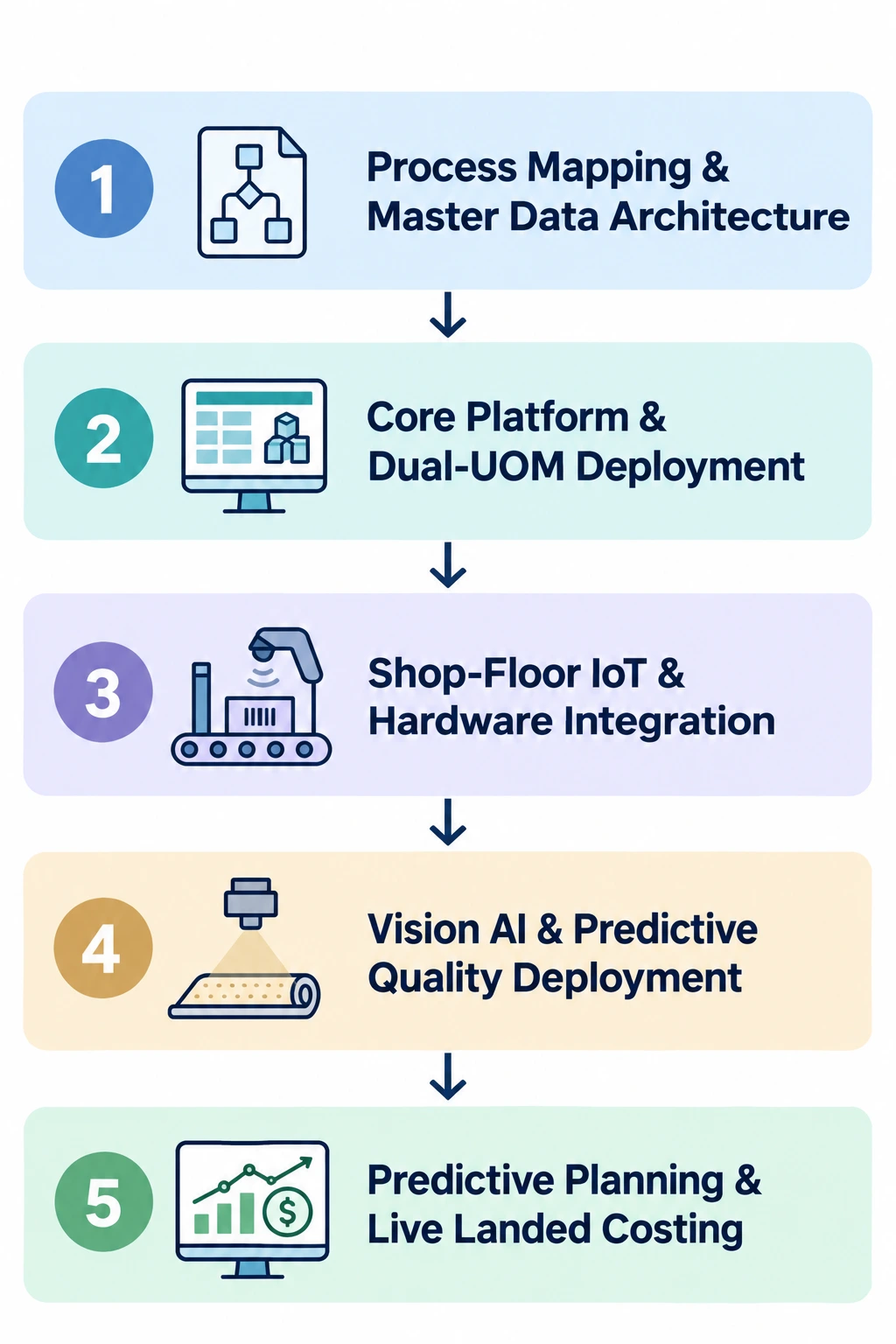
Stage 1: Process Mapping & Master Data Architecture: Map physical material flows from bale intake to finished cloth dispatch. Standardize yarn count conventions, fabric constructions, and chemical SKUs, and establish clean master bills of materials (BOMs) and standard routings across all lines.
Stage 2: Core Platform & Dual-UOM Deployment: Implement an enterprise system natively supporting linear meters and kilograms. Establish automated batch, lot, and dye shade group segregation while configuring role-based security permissions and digital approval hierarchies.
Stage 3: Shop-Floor IoT & Hardware Integration: Connect digital weighing scales directly to central ERP databases. Install pulse counters and runtime sensors on active spinning and weaving lines, and deploy rugged mobile barcode scanners and thermal printers across storage godowns.
Stage 4: Vision AI & Predictive Quality Deployment: Mount high-speed line-scan camera arrays over rolling inspection tables. Connect laboratory spectrophotometers directly to digital dye kitchens, and integrate digital defect maps with automated garment cutting software.
Stage 5: Predictive Planning & Live Landed Costing: Activate machine learning demand forecasting models on historical sales data. Turn on algorithmic loom scheduling and beam readiness notifications, and enable live job costing dashboards tracking real-time order profitability.
Transforming Textile Operations with Duocron Solutions, Powered By ERPNext
Mastering machine scheduling, predictive demand, high-speed defect detection, and live job costing requires software built specifically for the textile industry. Rigid, expensive legacy Tier-1 systems like SAP or Oracle often burden mills with high upfront costs, expensive per-user monthly licensing fees, and slow customization cycles that cannot match fast-changing textile operations.
Duocron Solutions provides a modern, proven alternative. Recognized globally as the leading ERPNext service provider, Duocron Solutions brings more than 11 years of deep industry experience and over 300 successful enterprise implementations across global markets. Duocron Solutions routinely handles complex, mission-critical digital transformation projects for private enterprise leaders and demanding public-sector agencies with precision.
Through focused software engineering, Duocron Solutions has customized ERPNext into an industry-ready platform that matches and outperforms costly Tier-1 legacy software. Duocron Solutions tailors ERPNext to meet the exact operational needs of mid-to-large-scale textile and apparel manufacturers, delivering:
Predictive Demand & Inventory Forecasting: Machine learning models that analyze historical sales and raw fiber prices to optimize procurement schedules.
Algorithmic Loom & Spindle Scheduling: Automated capacity balancing that minimizes warp beam swaps and machine changeover downtime.
Integrated Computer Vision Defect Logging: High-speed fabric inspection data integration that generates automated 4-point roll grades and digital defect maps.
Native Dual-UOM Architecture: Accurate tracking across linear meters, roll counts, and weight in kilograms, eliminating inventory discrepancies.
Computerized Dye Kitchen & Recipe Locks: Automated formulation verification that prevents operators from initiating dye cycles until chemical barcodes and weights match approved recipes.
Live Landed Job Costing: Real-time calculation of direct yarn costs, machine kilowatt-hours, labor hours, and finishing chemicals per finished roll.
Low Total Cost of Ownership: Zero recurring per-user software licensing penalties, allowing mills to scale from 50 to 2,500 shop-floor users affordably.
Whether you operate a spinning mill, a weaving shed, a modern knitwear dye house, or an integrated textile composite facility, Duocron Solutions provides the technical foundation and change-management support needed to turn your operations into an efficient, connected smart enterprise.
Stop letting unpredictable demand, idle looms, and unmonitored defect scrap erode your mill's profitability. Contact the enterprise implementation specialists at Duocron Solutions today to schedule your comprehensive operational review and request a live platform demonstration.
Frequently Asked Questions (FAQs)
How does an AI ERP for textile manufacturing improve loom scheduling?
An AI ERP for textile manufacturing improves loom scheduling by using constraint-based optimization algorithms that automatically sequence production orders. Instead of relying on manual whiteboard schedules, the software groups orders by yarn count, reed space, weave structure, and color family. This reduces warp beam changes, minimizes weft insertion adjustments, and balances loom runtimes. The system tracks beam delivery times from sizing ranges, ensuring replacement beams arrive at the loom shed before active beams run out. Duocron Solutions integrates automated production scheduling directly into ERPNext, helping mills eliminate machine idle time and maximize overall equipment effectiveness.
How does computer vision improve fabric quality inspection over manual tables?
Computer vision systems use high-resolution line-scan cameras mounted over moving fabric frames to inspect cloth at speeds exceeding 100 meters per minute. Deep learning models identify, categorize, and measure flaws like slubs, missing picks, holes, and oil stains with up to 98% accuracy, far outperforming manual inspection where human eye fatigue sets in after 30 minutes. The system marks defect coordinates and calculates roll penalty points based on international 4-Point inspection standards. Duocron Solutions integrates this inspection data directly into ERPNext, generating digital defect maps that automated cutting tables use to minimize fabric scrap.
What data inputs does AI textile demand forecasting require to be accurate?
AI textile demand forecasting requires a combination of internal and external data inputs. Internally, the algorithms analyze historical sales orders, SKU turnover rates, seasonal production volumes, current stock balances, and supplier lead times. Externally, the models evaluate raw cotton and polyester commodity market indices, freight cost trends, and regional weather forecasts. By processing these multi-variable data points together, machine learning models predict future yarn and fabric requirements with high precision. Duocron Solutions configures predictive forecasting engines within ERPNext to help textile mills optimize raw material purchases and prevent inventory buildup.
How does live landed costing in an AI-powered ERP calculate true order profitability?
Live landed costing calculates true order profitability by tracking actual shop-floor resource consumption as production occurs, rather than relying on standard monthly estimates. The software records the verified cost of raw fiber lots, monitors direct kilowatt-hours via machine IoT sensors, logs direct labor hours from operator scans, and measures exact chemical gram weights dispensed in the dye kitchen. It then credits back the market value of saleable scrap byproducts like comber noils or fabric remnants. Duocron Solutions builds real-time landed costing engines into ERPNext, giving plant executives immediate visibility into gross margins for every fabric style.
Why should textile manufacturers choose Duocron Solutions over legacy Tier-1 ERP software?
Legacy Tier-1 enterprise software platforms carry high upfront costs, expensive recurring per-user licensing fees, and rigid architectures that are difficult and slow to adapt to fast-changing textile operations. Duocron Solutions brings over 11 years of enterprise experience and more than 300 successful implementations worldwide to deliver an industry-ready ERPNext system customized for textile operations. Duocron Solutions delivers the deep shop-floor functionality, IoT machine connectivity, and dynamic costing of Tier-1 platforms at a fraction of the total cost of ownership, without restrictive per-seat licensing fees.
Author Bio

Aarav Sharma
Aarav Sharma is an ERPNext Consultant at DuoCron Solutions specializing in manufacturing ERP and process optimization. Outside work, Aarav enjoys exploring new technology trends and writing about digital transformation in manufacturing.